
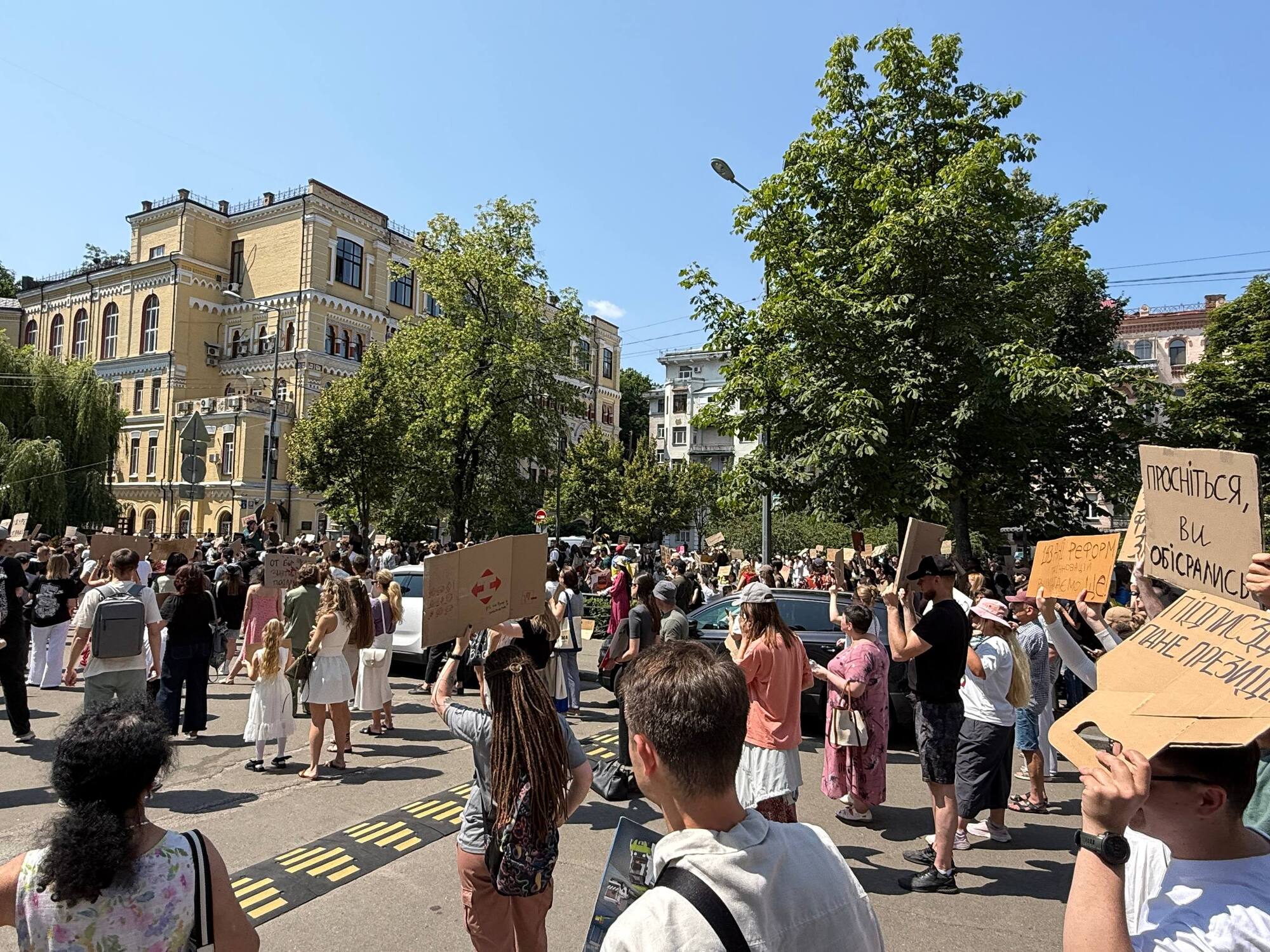
“Business Means Nothing When You Risk Losing Your Country”: Why Ukrainian Entrepreneurs Are Standing Behind the Protests
In recent weeks, Ukraine has witnessed a significant surge in civic activism, with business owners and entrepreneurs joining protest movements in unprecedented numbers. Founders of well-known Ukrainian companies including Hvoya, Honey, Inzhur, Sens, and numerous other enterprises have spoken to LIGA.net about their motivations for participating in street demonstrations, revealing a deep-seated commitment to democratic values that transcends commercial interests. Their involvement marks a notable shift in the relationship between Ukraine’s business community and political activism, signaling that economic success means little without a stable, democratic state to operate within.
The entrepreneurs who have taken to the streets represent a diverse cross-section of Ukraine’s growing startup ecosystem and established business community. These are not marginal players but successful founders who have built companies from the ground up, creating jobs and contributing to the national economy. Their decision to publicly align themselves with protest movements carries significant professional risks, including potential government scrutiny, loss of contracts, and damage to business relationships. Yet for many, these concerns pale in comparison to what they perceive as existential threats to Ukrainian democracy and sovereignty.
The involvement of business leaders in Ukrainian protests has deep historical roots, dating back to the Orange Revolution of 2004 and the Euromaidan protests of 2013-2014. During Euromaidan, entrepreneurs played a crucial role in sustaining the movement, providing food, supplies, and financial support to protesters occupying Independence Square. That experience fundamentally transformed how many Ukrainian business owners view their civic responsibilities, creating a generation of entrepreneurs who see political engagement not as optional but as essential to their identity as citizens and economic actors.
According to statements gathered by LIGA.net, the motivations driving business participation are remarkably consistent across different sectors and company sizes. Many entrepreneurs express the sentiment captured in the phrase “business means nothing when you risk losing your country,” reflecting a pragmatic understanding that economic activity depends on political stability, rule of law, and institutional integrity. Without these foundations, even the most successful enterprises become vulnerable to arbitrary interference, corruption, and collapse. This perspective has been reinforced by Ukraine’s turbulent recent history, including the full-scale Russian invasion that began in February 2022.
The war with Russia has particularly crystallized the relationship between business interests and national survival for Ukrainian entrepreneurs. Many companies have had to relocate operations, adapt to wartime conditions, or pivot entirely to support defense efforts. In this context, the distinction between “business” and “country” has become almost meaningless – the survival of one depends entirely on the survival of the other. Entrepreneurs who might have previously focused exclusively on growth metrics and profit margins now speak openly about democratic values, territorial integrity, and the importance of civic participation.
Political analysts note that the visible presence of business leaders in protest movements serves multiple strategic functions. Their participation lends credibility and mainstream legitimacy to demonstrations, countering narratives that portray protesters as marginal or radical elements. Business owners also bring organizational skills, resources, and professional networks that can amplify protest messages and sustain movements over time. Furthermore, their involvement signals to international partners and investors that Ukraine’s entrepreneurial class remains committed to European integration and democratic governance, potentially strengthening the country’s position in ongoing negotiations with Western allies.
The economic implications of business participation in protests are complex and multifaceted. Some entrepreneurs acknowledge that their public stance may cost them government contracts or expose them to regulatory harassment. However, many argue that the long-term costs of political passivity far outweigh short-term business risks. A country without functioning democratic institutions, they contend, cannot provide the predictable legal environment, protection of property rights, or access to international markets that sustainable business growth requires. In this calculation, protest participation becomes not just a civic duty but a rational business decision.
As Ukraine continues to navigate the challenges of war, reconstruction, and European integration, the relationship between its business community and civil society appears stronger than ever. The entrepreneurs speaking to LIGA.net represent a broader trend of civic engagement among Ukraine’s economic elite, one that could have lasting implications for the country’s political development. Their message is clear: in times of national crisis, commercial success becomes secondary to preserving the conditions that make any success possible. For these business leaders, standing in protest is not a distraction from their professional responsibilities but an extension of them – an investment in the future of the country where they hope to continue building their enterprises.