
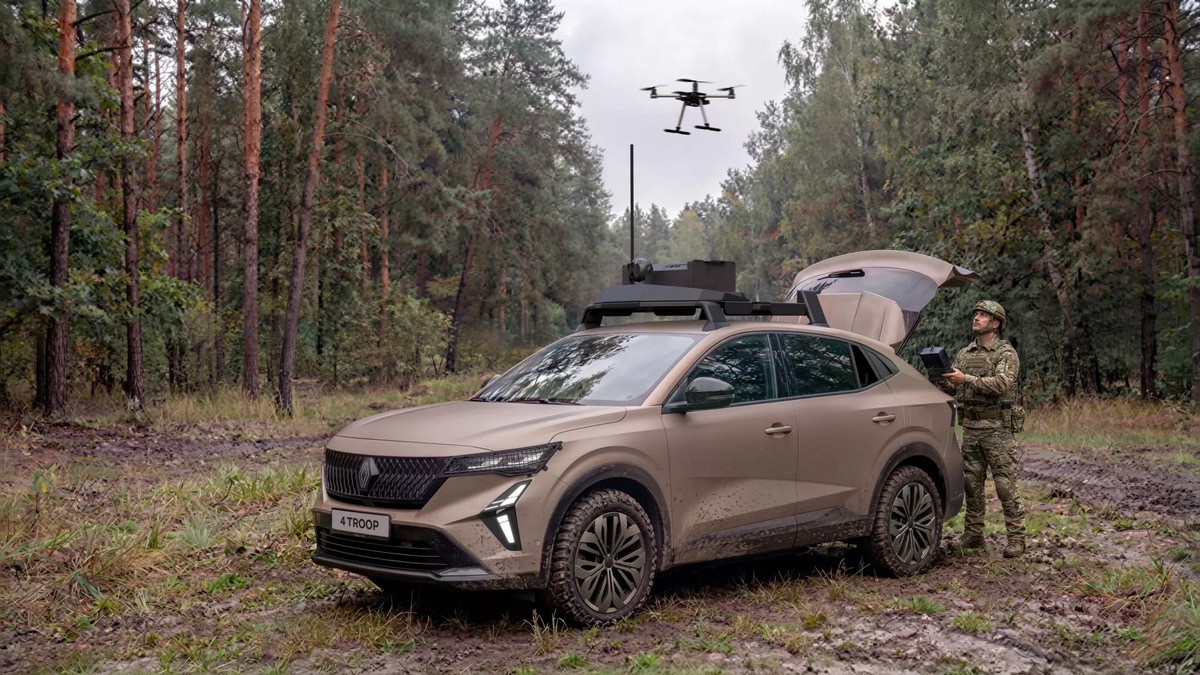
Renault Develops First Military Vehicle Based on Civilian Chassis Platform
French automotive giant Renault has unveiled a groundbreaking approach to military vehicle manufacturing by adapting its civilian automotive platforms for defense applications. The innovative project represents a significant shift in how armed forces may procure tactical vehicles in the future, combining the reliability and cost-effectiveness of mass-produced civilian technology with specialized military-grade communications systems developed by defense electronics specialist Thales.
The collaboration between Renault and Thales marks a notable convergence of civilian automotive engineering and military technology sectors. Under this partnership, Renault’s proven commercial vehicle platforms will undergo comprehensive modifications to meet the rigorous demands of military operations, while Thales will provide integrated battlefield communication systems essential for modern warfare coordination. This dual-expertise approach aims to deliver vehicles that maintain the serviceability advantages of civilian components while incorporating the secure, robust communication capabilities required by contemporary armed forces.
The concept of militarizing civilian vehicles is not entirely new, but Renault’s systematic approach represents a more formalized and technologically advanced iteration of this practice. Throughout military history, armed forces have frequently adapted commercial vehicles for wartime use, from requisitioned trucks during World War I to the famous “technical” pickup trucks seen in various modern conflicts. However, these adaptations were typically improvised solutions rather than purpose-engineered military variants. Renault’s program differs fundamentally by designing the military modifications as an integral part of the vehicle development process, ensuring that the resulting platform meets specific operational requirements from the outset.
The strategic implications of this development extend beyond mere cost savings. Modern military procurement programs have faced increasing criticism for spiraling costs and extended development timelines. Purpose-built military vehicles, while offering superior protection and capabilities, often require specialized manufacturing facilities, unique supply chains, and extensive training programs for maintenance personnel. By leveraging civilian platforms, Renault’s approach potentially addresses all these challenges simultaneously. Military mechanics familiar with commercial Renault vehicles could more easily service these modified platforms, spare parts would be more readily available through existing distribution networks, and production could be scaled more rapidly using established manufacturing infrastructure.
Thales, the French multinational company specializing in aerospace, defense, and digital identity systems, brings decades of expertise in military communications to the partnership. The company has been at the forefront of developing secure tactical communication networks, satellite systems, and electronic warfare capabilities for NATO forces and allied nations. The integration of Thales technology into the Renault platforms will likely include encrypted radio systems, battlefield management interfaces, and potentially GPS-denied navigation capabilities that have become essential in modern electronic warfare environments. Such systems allow military units to maintain situational awareness and command connectivity even in contested electromagnetic spectrums.
The French defense industry has historically maintained strong ties between civilian and military manufacturing sectors, with companies like Dassault producing both commercial aircraft and fighter jets. This latest Renault-Thales collaboration continues that tradition while potentially opening new export opportunities. Many allied nations, particularly those with limited defense budgets, have expressed interest in acquiring capable military vehicles without the premium pricing of fully bespoke tactical platforms. A militarized civilian vehicle offering 80 percent of the capability at significantly reduced cost could prove attractive to numerous defense ministries worldwide.
Industry analysts suggest this development may signal a broader trend in defense procurement philosophy. As military operations increasingly require rapid deployment and sustained logistics support, the advantages of vehicles that can be quickly produced, easily maintained, and operated by personnel with commercial driving experience become more apparent. The Renault program could serve as a template for other automotive manufacturers considering entry into the defense sector, potentially disrupting traditional military vehicle suppliers who have long dominated this specialized market. Whether this civilian-military hybrid approach will meet the demanding standards of frontline military service remains to be proven through extensive testing and, ultimately, operational deployment.