
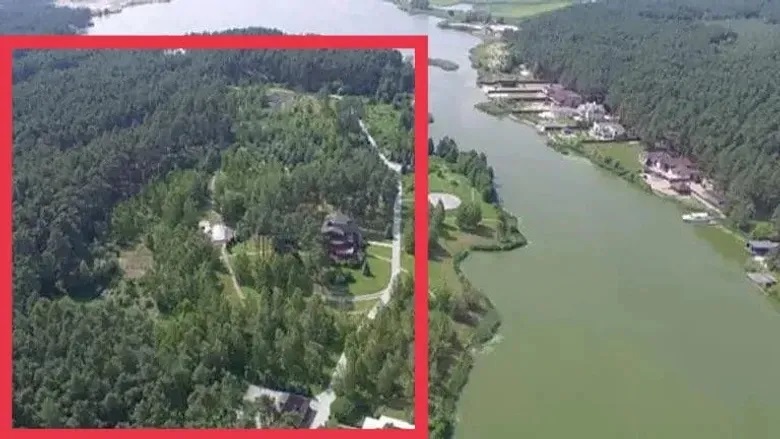
Ukrainian State Reclaims 10 Hectares of Land at Medvedchuk’s Riverside Estate in Kyiv Region
In a significant development in Ukraine’s ongoing efforts to seize assets linked to pro-Russian figures, the Ukrainian government has officially taken ownership of approximately 10 hectares of prime real estate located along the banks of the Stugna River in the Obukhiv district of the Kyiv region. The property, which served as a private estate belonging to Viktor Medvedchuk, one of Ukraine’s most prominent pro-Russian politicians, has now been transferred to state ownership following legal proceedings that determined the land was acquired through illicit means.
Viktor Medvedchuk, once considered the closest Ukrainian ally to Russian President Vladimir Putin, who is the godfather of Medvedchuk’s daughter, has been at the center of numerous legal battles since Russia’s full-scale invasion of Ukraine in February 2022. The politician, who led the now-banned Opposition Platform — For Life party, was detained by Ukrainian security services in April 2022 after attempting to flee the country. He was subsequently exchanged for Ukrainian prisoners of war held by Russia in September 2022 and has since resided in Russia.
The confiscation of this riverside property represents just one piece of a much larger puzzle in Ukraine’s systematic effort to nationalize assets belonging to individuals deemed to have collaborated with or supported Russian interests. Ukrainian authorities have identified billions of dollars worth of real estate, business holdings, and financial assets connected to Medvedchuk and his inner circle. The estate along the Stugna River, known for its scenic beauty and proximity to Kyiv, was reportedly used as a luxury retreat and featured extensive grounds with premium amenities befitting the lifestyle of one of Ukraine’s wealthiest political figures.
The legal framework for such asset seizures was strengthened considerably following the 2022 invasion, with Ukrainian parliament passing legislation that streamlined the process of identifying, freezing, and ultimately transferring ownership of properties linked to individuals accused of supporting Russian aggression. The National Agency for Detection, Search and Management of Assets Obtained from Corruption and Other Crimes, known as ARMA, has played a central role in managing these seized properties. Legal experts note that the Medvedchuk case has become something of a template for how Ukraine handles high-profile asset recovery cases.
Medvedchuk’s relationship with the Kremlin dates back decades, and his media empire once wielded considerable influence over Ukrainian public opinion. Before the war, he controlled several television channels that were accused of spreading pro-Russian narratives. These channels were shut down by presidential decree in 2021, a decision that drew both praise from those concerned about Russian influence and criticism from some media freedom organizations. His business interests spanned energy, manufacturing, and real estate sectors, creating a complex web of holdings that Ukrainian investigators have spent years untangling.
The Stugna River, which flows through the Kyiv region before joining the Dnipro River, has historically been an area of desirable real estate for Ukraine’s elite. The river valley offers natural beauty, recreational opportunities, and relative seclusion while maintaining proximity to the capital city. Properties along its banks have long commanded premium prices, making the 10-hectare estate a particularly valuable addition to state holdings. Ukrainian officials have indicated that seized properties like this one may be repurposed for public benefit, potentially serving as facilities for veterans, displaced persons, or other social programs necessitated by the ongoing conflict.
The transfer of Medvedchuk’s property to state ownership also carries symbolic significance in Ukraine’s broader narrative of breaking free from Russian influence. Since 2014, when Russia annexed Crimea and supported separatist movements in eastern Ukraine, successive Ukrainian governments have worked to reduce the political and economic leverage that pro-Russian oligarchs wielded. The full-scale invasion accelerated these efforts dramatically, transforming what had been gradual de-oligarchization into urgent national security measures. As Ukraine continues to defend its sovereignty while simultaneously pursuing European integration, the seizure of assets like the Stugna estate demonstrates the country’s commitment to dismantling networks that once connected it to Moscow’s sphere of influence.